













Book a Consultation
Breast Surgery

Breast Augmentation

Mr Nakul Patel offers breast enlargement in Leicester & Nottingham and across the East Midlands, taking an individualised approach that carefully considers your anatomy, lifestyle and goals to achieve a natural-looking, balanced result.

1–1.5h
Procedure Time
Day Case
Hospital Stay
1–2wk
Time Off Work
1–2wk
Driving
6 Weeks
Support Bra
3–6wk
Exercise

Fuller, more proportionate breasts — without looking overdone

Breast enlargement, also known as breast augmentation, is a surgical procedure to increase the size and enhance the shape of the breasts, most commonly using silicone implants placed either behind the breast tissue or partially under the chest muscle. The aim is to create fuller, more proportionate breasts that fit comfortably with your frame and feel in keeping with your overall body shape and personal style. Many women choose breast enlargement to restore volume lost after pregnancy or weight change, to improve symmetry where one breast is smaller than the other, or simply to feel more confident in and out of clothing.

Mr Nakul Patel during a patient consultation

What Is Breast Augmentation?

The aim is to enhance, not overwhelm, your frame — a result that looks harmonious from both the front and side.

Breast enlargement is an operation to increase breast volume and enhance shape using implants, with the aim of achieving fuller, more proportionate breasts that align with your preferences and lifestyle. The procedure can address naturally small breasts, loss of volume after pregnancy or weight changes, or asymmetry where one side is smaller, helping many patients feel more balanced and confident in their body.

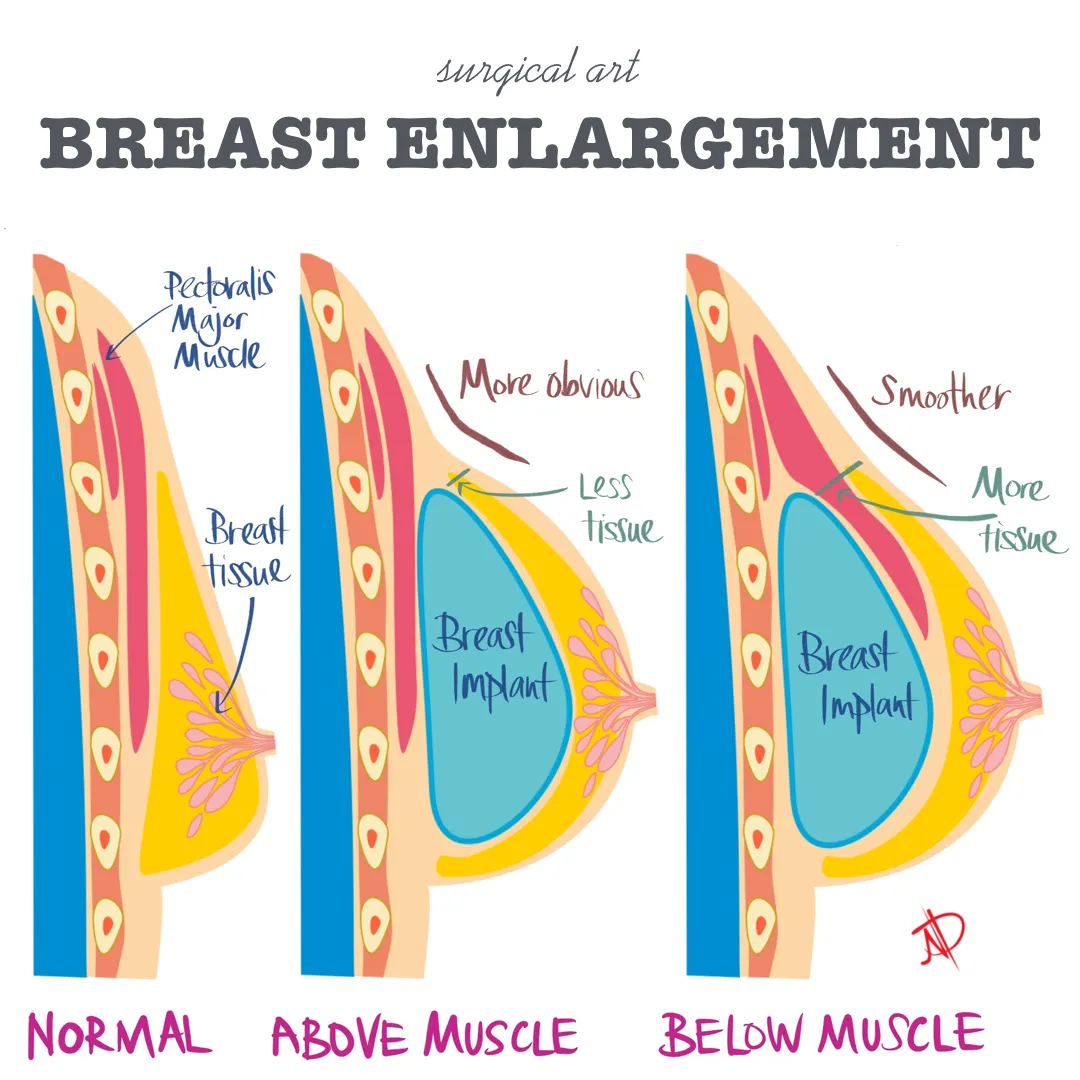
During surgery, a carefully planned pocket is created either behind the breast gland (subglandular) or partly under the pectoral muscle (dual-plane), and a silicone implant is inserted to achieve the agreed size and shape. The incision is usually placed in the crease under the breast (inframammary fold) to keep scars discreet and well-hidden in most clothing and swimwear.

Implants vary in size, projection and profile, and can be round or anatomical (teardrop-shaped). Mr Patel will guide you through these choices using measurements, photographs and sizers to help you visualise a realistic outcome. The overarching aim is to enhance, not overwhelm, your frame — creating a result that looks and feels harmonious from both the front and side views.

What Augmentation Can Achieve

In appropriately selected patients, breast augmentation offers a blend of physical, aesthetic and quality-of-life improvements.

Restoration of Volume

Restores breast volume and firmness lost after pregnancy, breastfeeding or significant weight change.

Improved Body Balance

Improves balance between the upper and lower body, which can help clothing and swimwear fit more proportionately.

Correction of Asymmetry

Can address differences in size or shape between the two breasts.

Improved Ease With Activity

In selected patients, improved breast proportion may make certain physical activities more comfortable.

Mr Patel will discuss these potential benefits in the context of your specific starting size, breast characteristics and goals, helping you decide whether breast augmentation is the right option for you.

★★★★★
“It's the best thing I've done for myself.”
Patient · Nottingham

Is This the Right Procedure for You?

Careful patient selection is essential to maximise safety and satisfaction. Mr Patel will explore both surgical and non-surgical options with you so any decision to proceed is fully informed.

  • Feel your breasts are smaller than you would like, or out of proportion with your hips and overall frame
  • Have lost breast volume or shape after pregnancy, breastfeeding or significant weight changes
  • Have noticeable asymmetry between your breasts that affects clothing, bras or your confidence
  • Have realistic expectations about size, shape and scarring, understanding perfect symmetry cannot be guaranteed
  • Are in good general health, with a stable weight ideally in or near the recommended BMI range
  • Do not smoke, or are willing to stop and avoid nicotine before and after surgery
  • Your BMI or weight significantly increases your risk of complications — weight optimisation may be recommended first
  • You are currently smoking or using nicotine products and are not yet ready to stop
  • Medical conditions such as diabetes, cardiovascular disease or clotting disorders are not yet optimally controlled
  • You are pregnant, breastfeeding, or planning pregnancy in the very near future
  • There are plans for long-haul travel very close to the time of surgery, which may increase clot risk

Padded or push-up bras and specialist lingerie to enhance volume and cleavage without surgery.

Strength training focusing on the chest and upper body to improve posture and chest contour.

Fat transfer (lipofilling) alone, for subtle enhancement in suitable patients.

Accepting your current breast size — non-operative management is always a valid choice.

Shape, Size & Surface

Every decision is made with your anatomy, tissue quality and aesthetic goals in mind — not a one-size-fits-all template.

Shape

Round vs Anatomical

Round Implants

Tend to give more fullness in the upper part of the breast and are very versatile across different pocket positions and sizes. When sized appropriately, they can look natural while providing a fuller cleavage.

Anatomical Implants

Fuller in the lower part and gently sloping at the top, aiming to mimic the natural breast shape. They may be helpful in selected patients wanting subtle enhancement, but they can rotate, which may occasionally require correction.

Surface

Smooth vs Textured

Smooth

Have a smooth surface and can move more freely within the pocket, which some patients feel gives a softer, more mobile breast in certain situations.

Textured

Have a slightly rough surface designed to reduce capsular contracture in some placements, and to help shaped (anatomical) implants stay correctly oriented.

Size

Volume & Projection

Smaller

Subtle, natural volume

Moderate

Balanced, proportionate lift

Fuller

More dramatic projection

Implant size is measured in millilitres (cc) rather than cup size. The right size depends on your chest width, soft-tissue thickness, skin stretch and desired look. Larger implants can give a more dramatic change but may look less natural in slimmer women, and can place more weight on breast tissue over time. Mr Patel will use chest measurements, example images and sizers to help identify a size range that enhances your proportions without overwhelming your frame.

Mr Patel will discuss these options in detail, taking into account your tissue characteristics, lifestyle, preferences and the most up-to-date safety information, before agreeing a plan that best suits you.

Types of Breast Augmentation

There is no single technique that suits every patient — Mr Patel tailors the method to your tissue and goals.

Technique Best For Key Features Scars Typical Look
Subglandular Good breast tissue & skin quality No muscle dissection; quicker recovery Short scar in breast crease Fuller upper pole
Dual-Plane Slimmer patients or mild droop Upper implant under muscle; excellent coverage Scar in breast crease Soft, natural slope
Lipofilling Subtle enhancement with donor fat Own fat; no implant; may need multiple sessions Tiny liposuction scars Very soft, natural feel
MIA / Preserva Modest enhancement; minimal scarring Smaller implants; shorter incisions; less tissue disruption Very short, discreet incisions Subtle, natural

← Swipe to compare →

Surgical art illustration of breast enlargement implant placement
Every technique is tailored during consultation using measurements, diagrams and sizers.

Before & After

Drag the handle to compare. Contains clinical imagery — hidden by default.

Before
After
Clinical Before & After Contains medical nudity · 18+

Breast Augmentation · drag to compare

Before
After
Clinical Before & After Contains medical nudity · 18+

Breast Augmentation · drag to compare

Before
After
Clinical Before & After Contains medical nudity · 18+

Breast Augmentation · drag to compare

From First Consultation to Recovery

Sixteen steps, four phases, one continuous path — click any step to read Mr Patel's full guidance.

Phase 1 of 4

Consultation

First Consultation

A detailed discussion of your history, goals and anatomy — followed by measurements, sizers and photographs to help you visualise your options.

The initial consultation is an opportunity for Mr Patel to understand your concerns, motivations and goals, and to assess whether breast enlargement is appropriate for you. This includes a detailed discussion of your medical history, medications, weight and smoking status, as well as any previous breast surgery or family history of breast cancer. A clinical examination of the breasts and chest is carried out, with measurements and photographs taken as part of the planning process and medical record. Mr Patel may use implant sizers, diagrams and, where appropriate, imaging or photographs to help you visualise different size ranges and shapes. You are encouraged to discuss desired size and style, bring photographs that reflect your preferences, and ask questions about implant choice, scar position, recovery and long-term changes.

Cooling-Off Period

Time built in after your first visit to reflect, discuss with family, and reach a considered decision rather than a rushed one.

Following your first consultation, a cooling-off period is built into Mr Patel's practice to allow you time to reflect on the information given and to discuss matters with family or friends if you wish. This supports a considered decision rather than a rushed one, particularly for elective and long-lasting cosmetic procedures.

Second Consultation

Revisiting and confirming implant type, pocket position and incision site, with screening, breastfeeding and recovery reviewed in full.

A second consultation allows you to revisit and confirm the plan, including implant type, pocket position, incision site and size range, and to ensure that all your questions have been answered. The impact on future screening, mammography, breastfeeding and exercise will be reviewed, along with anaesthetic considerations and your recovery timeline. There is no pressure to proceed, and additional appointments can be arranged if you need more time or discussion before making a final decision. In some cases, particularly where body image concerns are complex, Mr Patel may recommend collaborative care with your GP or a psychologist to support holistic decision-making.

Phase 2 of 4

Preparing for Surgery

Medicines & Supplements

Certain painkillers, blood thinners and supplements like fish oils may need to be paused 1–2 weeks before your surgery.

  • Provide a complete list of all prescribed medications, over-the-counter treatments, herbal products, and supplements.
  • Blood-thinning medicines and certain painkillers (such as aspirin or ibuprofen) may need to be paused or adjusted before surgery.
  • Some supplements, including fish oils, high-dose vitamin E and certain herbal remedies, can affect clotting and may be stopped 1–2 weeks before surgery.

Smoking & Nicotine

Stopping ideally 4–6 weeks beforehand — and staying off nicotine through recovery — meaningfully lowers your risk of wound problems.

Smoking and nicotine (including vaping and nicotine replacement products) significantly increase the risk of wound problems, infection, and loss of skin or nipple tissue. Mr Patel strongly advises stopping well before surgery — ideally 4–6 weeks — and continuing to avoid nicotine throughout your recovery.

Weight & BMI

A stable, healthy weight supports a safer anaesthetic, fewer wound complications and more predictable, lasting results.

A stable, healthy weight helps to reduce anaesthetic risk, wound complications, and blood clots, and also leads to more predictable long-term results. If your BMI is significantly above 30, Mr Patel may recommend weight optimisation before surgery.

General Preparation

Balanced meals, good hydration, gentle activity and support arranged at home — the small things that add up beforehand.

  • Maintain a balanced diet, good hydration and gentle regular activity in the weeks before surgery.
  • Avoid heavy alcohol intake and crash dieting, as these can impair healing.
  • Arrange practical support at home for the first 1–2 weeks.
  • If you develop a new illness close to your surgery date, contact the team, as it may be safer to postpone.
Phase 3 of 4

Hospital Journey

Admission

Meeting the nursing team, reconfirming consent with Mr Patel, final markings, and a briefing from your anaesthetist.

On arrival at the hospital, you will be welcomed by the nursing team and shown to your room. Mr Patel will visit you to review the plan, reconfirm consent, check any implant choices and perform final surgical markings on your breasts and chest. You will also meet your anaesthetist, who will review your medical history and explain the anaesthetic and pain-relief plan.

Going to Theatre

You're escorted to theatre and given a general anaesthetic, so you'll be fully asleep and comfortable throughout.

When it is time for your operation, you will be escorted to the operating theatre. Breast enlargement is performed under general anaesthetic, so you will be asleep and comfortable throughout.

10
Key Milestone

The Operation

Once you are asleep, the operation proceeds in a carefully planned sequence tailored to your anatomy and the agreed implant and pocket choice. Typically, this includes:

  1. Making a small incision in the agreed site, most commonly in the fold under the breast (inframammary crease).
  2. Creating a precise pocket either in front of or partially under the pectoral muscle to house the implant.
  3. Inserting a sterile silicone implant using techniques designed to minimise bacterial contamination and handling.
  4. Checking symmetry, position and shape in both the sitting and lying positions, making fine adjustments as needed.
  5. Closing the wound in layers with dissolvable sutures; drains are not routinely required but may be used in specific situations.
  6. Applying dressings and a supportive bra or bandage before you leave theatre.

Recovery & Discharge

Closely monitored while you wake, then home the same day or after one night with clear aftercare instructions.

After surgery, you will wake in the recovery area, where your breathing, pain and comfort are closely monitored before you return to the ward. Your breasts will feel firm and swollen, and there may be bruising across the chest. You will be given appropriate pain relief and encouraged to start gentle mobilisation. Most patients go home the same day or after one night in hospital. Before discharge, you will receive written aftercare instructions, advice about your bra and dressings, medication, and clear contact details for any urgent concerns.

Phase 4 of 4

Recovery After Breast Enlargement

Recovery is gradual and varies depending on the implant chosen, pocket placement and your general health. Mr Patel will guide you through each stage with a personalised aftercare plan.

12
Key Milestone

Week 1 — Early Recovery

  • Expect swelling, bruising, tightness and discomfort across the chest, particularly when moving your arms.
  • Keep your support bra on day and night as advised; this helps support the implants and reduce swelling.
  • Avoid lifting, overhead reaching and sudden arm movements.
  • Gentle walking from the first day or two helps reduce the risk of blood clots.
  • You will usually have a wound check with the team around 7–10 days after surgery.

Weeks 2–3 — Regaining Comfort

Tenderness settles as most return to light work, continue the support bra, and ease back into driving.

  • Pain and bruising begin to settle, although some tenderness and firmness of the breasts is common.
  • Many patients feel able to return to light or desk-based work after 1–2 weeks.
  • Continue wearing the support bra, and avoid strenuous upper-body activity.
  • You can usually return to driving once you are able to move your arms comfortably and tolerate the pressure of a seatbelt.

3–6 Weeks — Returning to Normal Activities

Gradual reintroduction of exercise, lower-body first, with the support bra worn for at least 6 weeks.

  • Most patients can resume normal day-to-day activities, with gradual reintroduction of exercise.
  • Lower-body and light exercise can typically start around 4 weeks, with more intensive upper-body training around 6 weeks as advised.
  • The support bra is often worn for at least 6 weeks.

3–6 Months — Settling Phase

Swelling continues to soften as implants settle and scars begin to fade and flatten.

  • Swelling continues to improve, and the breast shape becomes softer and more natural as the implants settle.
  • Scars may remain pink and slightly raised but will gradually fade and flatten over time.
16
Key Milestone

12–18 Months — Final Outcome

  • The final breast shape and implant position stabilise, although natural ageing, weight changes and pregnancy can still influence future appearance.
  • Scars usually reach their more mature appearance between 12 and 18 months, although they remain permanent.

Mr Patel's Approach to Scar Optimisation

Strong emphasis is placed on scar quality from the outset, from the operating table through to the final months of healing.

During Surgery

Wounds are carefully closed in multiple layers using fine suturing techniques, planned to keep the scar as discreet as possible from the outset.

Early Healing

Dressings are selected for your skin type and healing, with Micropore tape or similar products often used to support the wound in the first weeks.

Longer-Term Care

A routine of gentle moisturising, massage and silicone gel or tape, together with consistent sun protection, helps scars fade to a fine line over 12–18 months.

Risks & Complications

Breast augmentation is well-established and generally safe in appropriately selected patients. As with all surgery, there are risks Mr Patel will discuss with you in detail — expand each section below to read more.

  • Pain, bruising & swelling — normal in the first 1–2 weeks
  • Tightness & firmness of the chest, which gradually settles
  • Sensation changes in the nipple or breast, which usually improve over time
  • Delayed healing or infection — may need antibiotics or further treatment
  • Bleeding or haematoma — sometimes requiring return to theatre
  • Capsular contracture — scar tissue tightens around the implant
  • Implant rippling — particularly in slim patients or subglandular placement
  • Asymmetry in breast size, shape or implant position
  • Dissatisfaction with the cosmetic outcome
  • Need for revision or secondary procedures
  • Implant rupture or failure — may need further surgery
  • Implant extrusion (very rare) — implant exposed through the skin
  • Chronic breast or chest pain
  • BIA-ALCL — very rare lymphoma, mainly textured-implant association
  • BIA-SCC — extremely rare carcinoma in the implant capsule
  • DVT / PE — blood clots in the legs or lungs
  • Anaesthetic complications
Breastfeeding & Future Screening

Breast augmentation does not routinely prevent breastfeeding, but it may affect milk production or comfort, especially with certain incisions. Nipple and breast sensation can change; for many patients this improves over time, though partial or persistent alteration is possible. Implants do not stop you having mammograms, ultrasound or other imaging — but always tell your radiology team about your implants so appropriate techniques can be used.

Mr Patel takes a careful, personalised approach to risk reduction — including thorough pre-operative assessment, meticulous surgical technique, appropriate measures to reduce blood-clot risk, and close postoperative follow-up.

★★★★★
“I couldn't be happier with the results — completely natural, exactly what I asked for.”
Patient · Leicester

Frequently Asked

It depends on your chest width, tissue thickness, skin stretch and desired look. Round or anatomical, smooth or textured, subglandular or dual-plane — Mr Patel discusses these using measurements, sizers, diagrams and photographs before any decision is made.

Yes. Silicone is used in many medical devices, including heart valves. Extensive long-term research has found no evidence linking silicone breast implants to systemic disease, autoimmune conditions or breast cancer.

Implants are not lifetime devices. Many patients keep them 15–20+ years without issue, but it is common to need replacement or removal after around 10 years — this is discussed fully at consultation.

You should be able to breastfeed, and there is no evidence silicone passes into breast milk. In some cases, changes in nipple sensation or the surgery itself may affect breastfeeding capability, which is discussed openly beforehand.

Implants can interfere with standard mammography. Always tell your screening team you have implants — additional views, ultrasound or MRI may be used to check the breast tissue properly.

The most common incision sits in the breast crease, concealed by most bras and swimwear. With good scar care, most scars fade to a fine, inconspicuous line within 12–18 months.

Take the First Step
Ready to Begin
Your Journey...

Book a private consultation with Mr Nakul Patel to discuss your goals and explore your options in a warm, confidential setting.

Book a Consultation